


Which $15,000 diamond should you buy?
The choice comes down to one question: Asset Class vs. Visual Class.
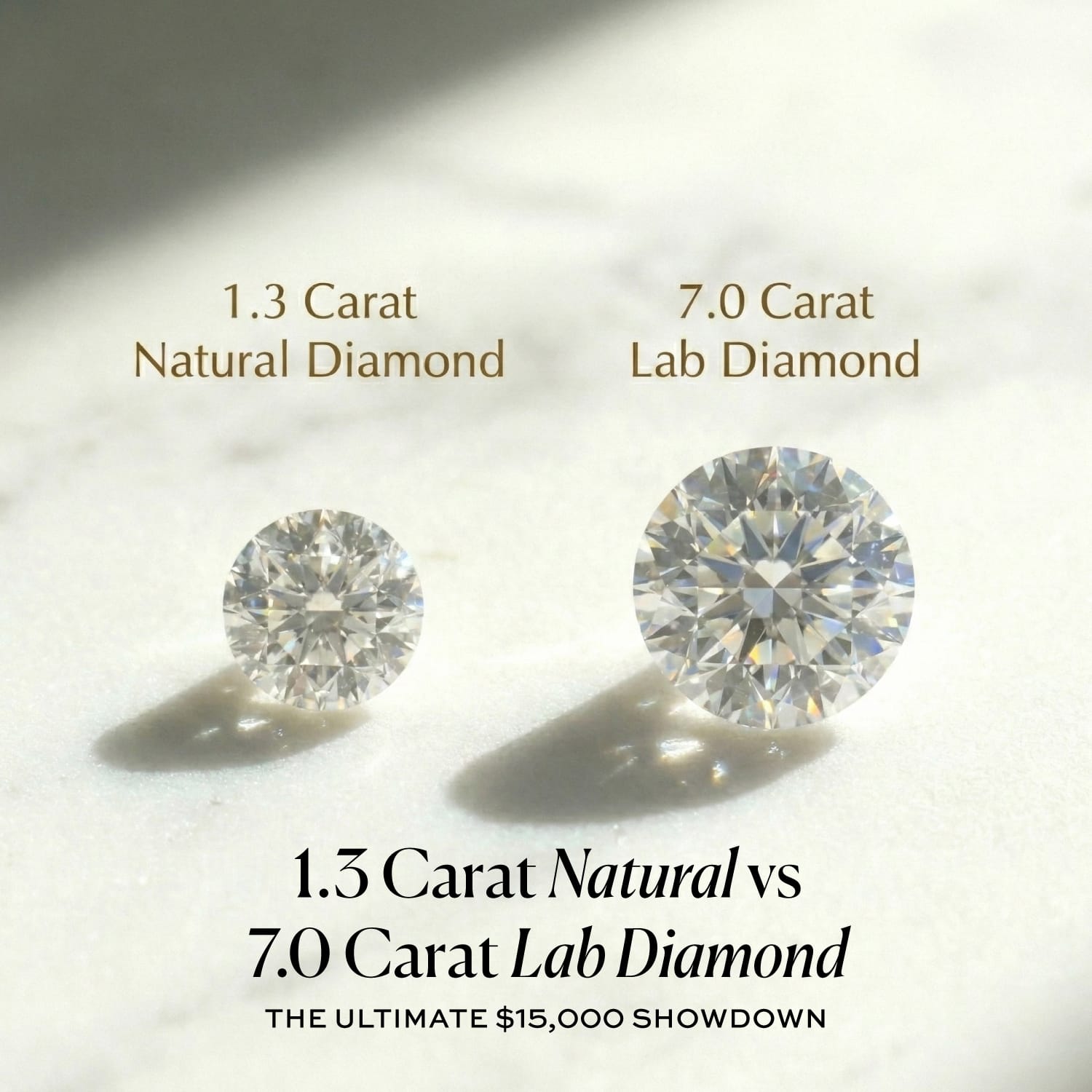
- The Asset (Natural): A GIA Certified 1.25 – 1.60 Carat diamond holds geological rarity and ~50% resale value.
- The Visual (Lab-Grown): A GIA/IGI Certified 5.00 – 7.02 Carat diamond provides 500% more finger coverage and celebrity status but holds near-zero resale value.
- Mehedi’s Pick: Unless you are a collector, buy the 7.02ct Lab. The visual difference is simply too massive to ignore.
Deal Alert: Mother’s Day Sale Up To 30% Off* select fine jewelry at Blue Nile.
New Collection: Shop the James Allen Collection at Blue Nile.
Vault Sale: “Clear The Vault” – Get up to 70% OFF at Blue Nile!
Flash Sale: Save up to 40% OFF sitewide at Rare Carat.
Exclusive: Get up to 60% OFF select fine jewelry at Ritani.
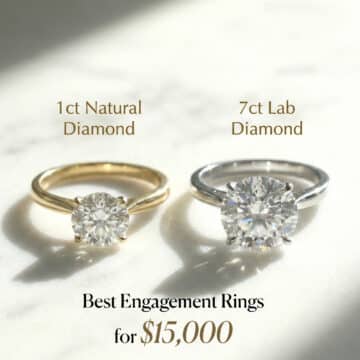
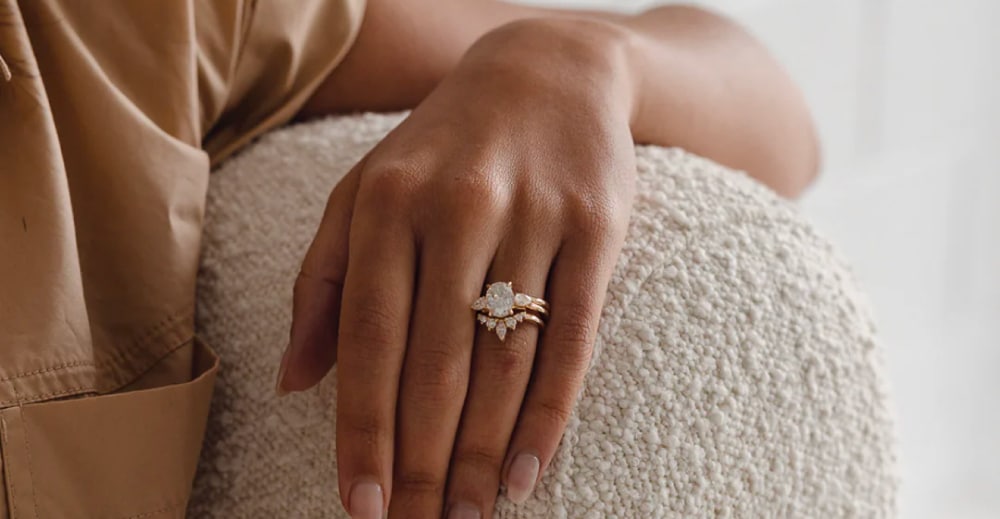
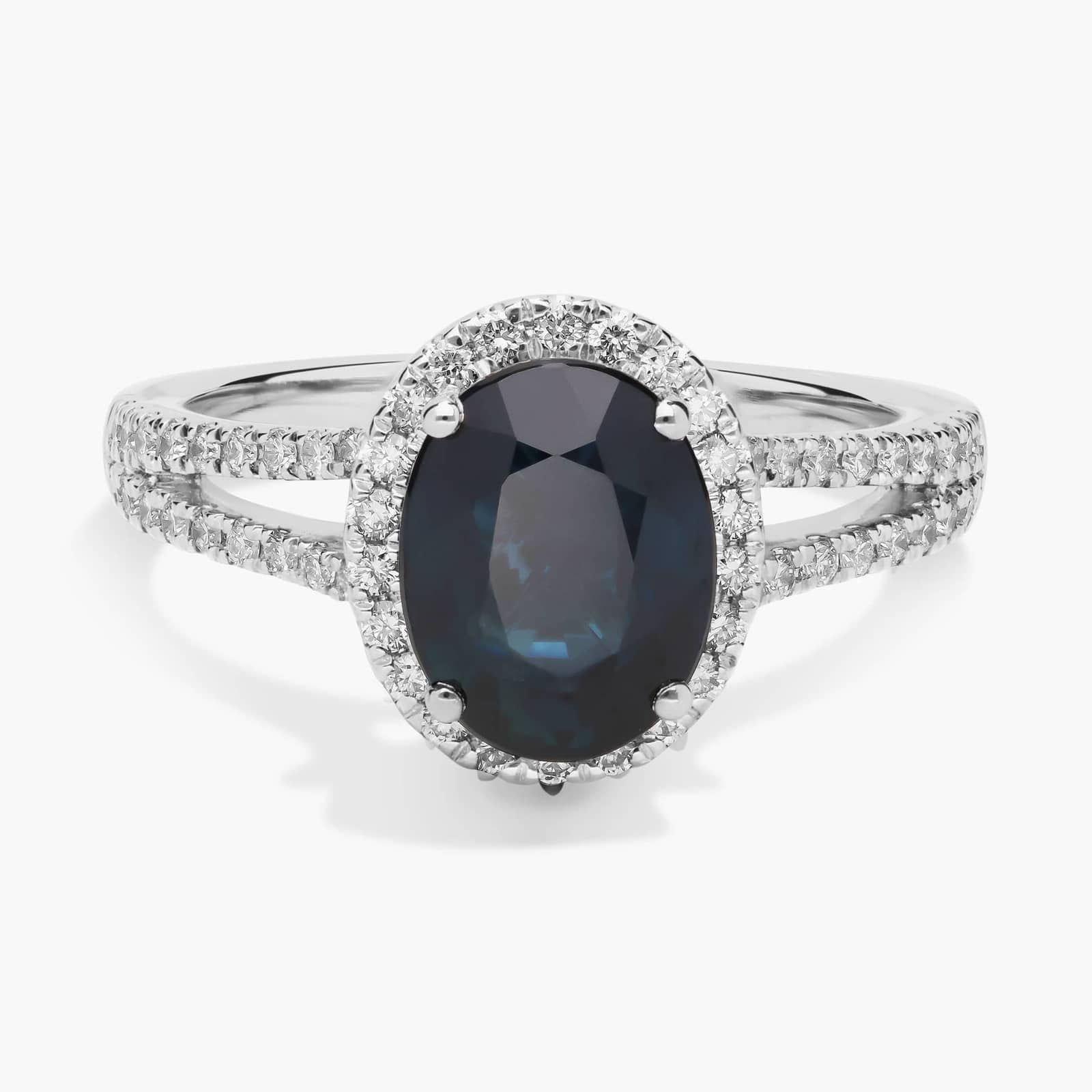
We are looking at two engagement rings.
One ring holds a stunning, classic, flawless 1.30 Carat Natural Diamond.
The other ring holds a blinding, hand-covering, flawless 7.02 Carat Lab-Grown Diamond.
Here is the twist: They both cost exactly $13,000.
At the $15,000 total budget tier, you are faced with the most extreme “Fork in the Road” decision in the entire jewelry industry.
For years, salespeople told you that Lab-Grown meant getting a 3-carat stone. They lied (or their info is old). The 2026 Inventory Analysis I conducted of James Allen and Blue Nile reveals that $13,000 (your allocated stone budget) now secures diamonds so large they were previously reserved for royalty.
I’m Mehedi, and I am going to put these two stones in a digital wrestling match—physics vs. finance—to help you decide if you want to wear History or Architecture.
Diamond IQ Test: Natural or Lab-Grown?
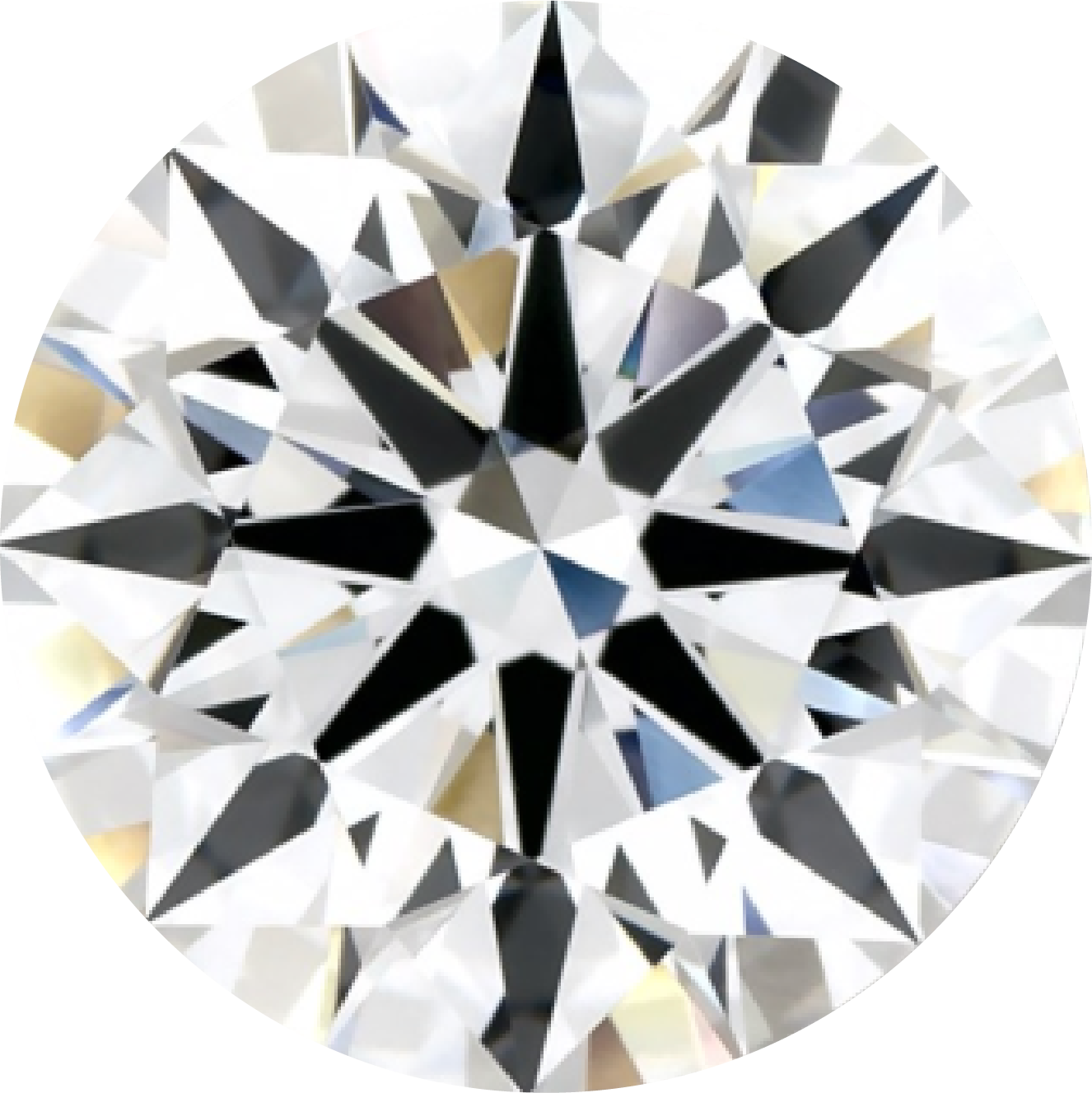
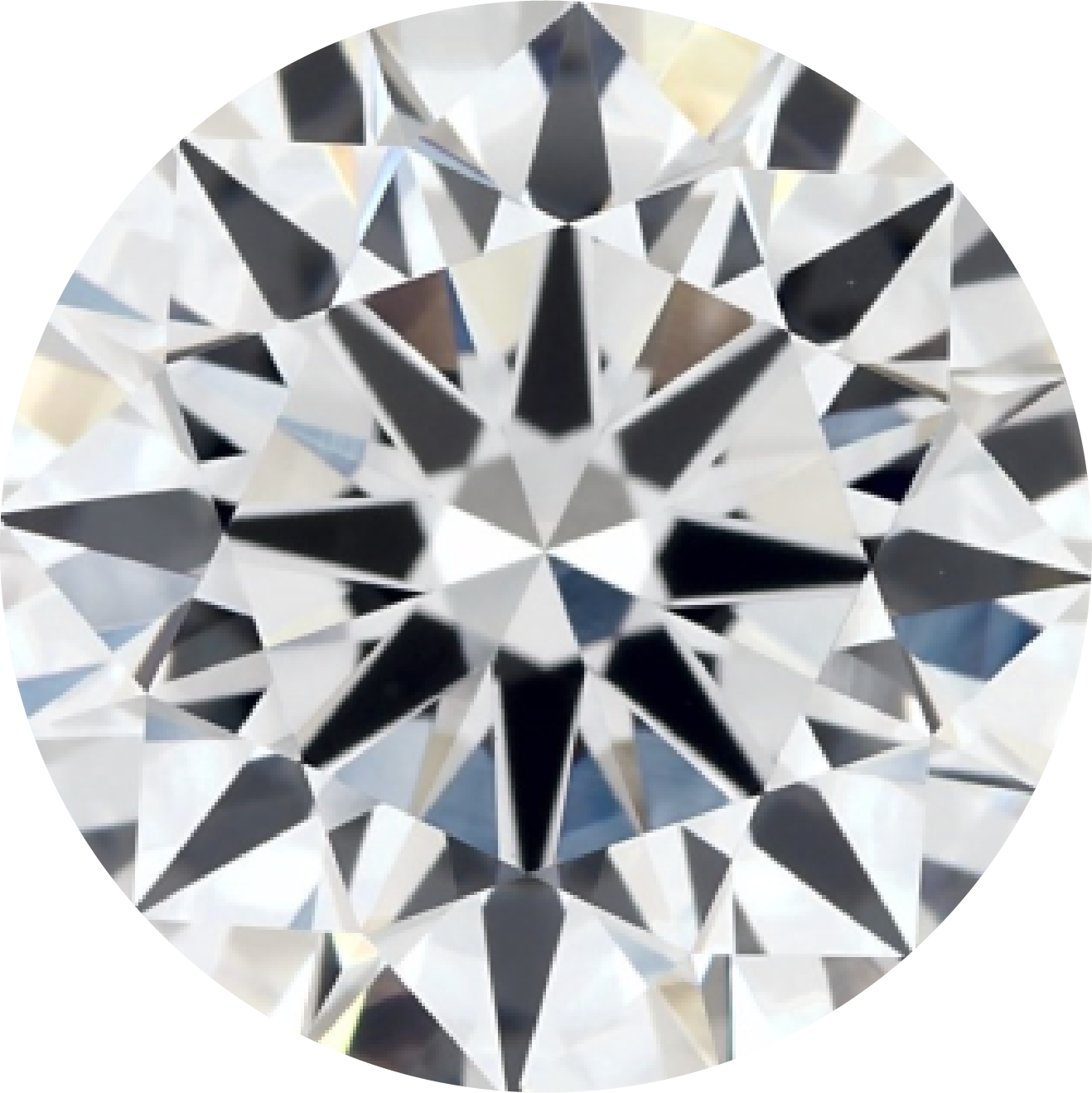
Two identical diamonds: GIA Certified, 1.51ct, D Color, VVS1, Ideal Cut. One is natural ($16,240), the other is lab-grown ($1,970). Choose the diamond you like better and see if you can match it to its origin.
Round 1: The Size Shock (Physics)
Most people cannot mentally visualize 7.00 Carats because they have never held it.
Let’s break down the physical dimensions of the stones we found in the inventory search.
Contender A: The Natural GIA 1.31ct
- Inventory Finding: GIA 1.31 Carat D-VS1 Excellent Cut Round Diamond ($12,950).
- Diameter: ~7.0 mm.
- Finger Coverage (Size 6): Roughly 40% of the finger width.
- Visual Vibe: Elegant, understated, standard luxury. It looks “Real” and “Proper.”
Contender B: The Lab-Grown IGI 7.02ct
- Inventory Finding: IGI 7.04 Carat F-VVS2 Ideal Cut Round Lab-Grown Diamond ($12,910).
- Diameter: ~12.4 mm.
- Finger Coverage (Size 6): Roughly 75% – 80% of the finger width.
- Visual Vibe: Domineering. It essentially hides the ring band beneath it. It catches light from across a crowded room.
The “Surface Area” Calculation:
It’s not just “7 is bigger than 1.3.” It’s geometry.
- Area of 1.31ct Stone: ~38.5 mm².
- Area of 7.02ct Stone: ~121 mm².
- Result: The Lab Diamond presents 3.1x MORE sparkling surface area to the eye.
Mehedi’s Verdict: If your goal is to “Win the Room,” Natural doesn’t stand a chance. The 7-carat stone is an event; the 1.3-carat stone is an accessory.
Check the charts: To see exactly what shape maximizes this effect, review our what shape diamond looks the largest analysis.
Round 2: The “Investment” Myth vs. Reality
This is the main argument for buying Natural: “But Lab Diamonds are worthless!”
Let’s actually look at the math.
Scenario A: Buying the $12,900 Natural Diamond
- Year 1: You pay $12,950.
- Year 5 (Resale): Natural Diamonds have liquidity. You can sell it. But you cannot sell it for retail price. You will likely get a “wholesale buyback” offer of roughly 50% – 60%.
- Cash Value: ~$6,500 – $7,500.
- Loss: ~$6,000.
Scenario B: Buying the $12,900 Lab Diamond
- Year 1: You pay $12,910.
- Year 5 (Resale): The Lab market is a race to the bottom on price. Technology gets cheaper every year. A used Lab diamond has near zero commercial resale value (pennies on the dollar).
- Cash Value: ~$500 – $1,000 (optimistic).
- Loss: ~$12,000.
The Truth: Both diamonds lose you money. Engagement rings are terrible “Investments.”
- With Natural, you lose $6,000.
- With Lab, you lose $12,000.
Mehedi’s Strategy: Ask yourself: “Is it worth ‘losing’ an extra $6,000 over five years to wear a stone that is three times larger every single day?” For most luxury buyers, that “rental fee” for the status symbol is worth it.
- Read more: Get the raw numbers on How much can a diamond be sold.
Round 3: Optical Perfection (The Quality Test)
“Size” and “Price” are obvious. But what about Beauty?
Normally, cheap natural diamonds (in the $12k for 2ct range) look cloudy. But our specific $15,000 strategy changes that.
- The Natural Specs:D Color, VS1 Clarity. (See 1.04 ct Natural Round D-VVS1 listing).
- The Look: “Icy White.” D-Color is the highest grade possible. There is zero yellow tint. VS1 clarity is microscopic perfection. This stone is a scientific masterpiece.
- The Look: “Icy White.” D-Color is the highest grade possible. There is zero yellow tint. VS1 clarity is microscopic perfection. This stone is a scientific masterpiece.
- The Lab Specs:F Color, VVS2 Clarity. (See 7.04 ct Lab Round F-VVS2 listing).
- The Look: “Colorless.” F-Color is visually identical to D-Color once mounted. VVS2 is arguably cleaner than VS1.
Mehedi’s Analysis:
Because Lab technology (HPHT/CVD) creates stones in controlled environments, we can grow “Perfect” stones easier than finding them.
With the 7.04ct stone, you aren’t sacrificing quality to get size. You are getting VVS clarity on a massive surface area—something that would cost $400,000 in nature.
The “Optical Penalty” for going Lab-Grown is Zero.
Round 4: The Setting Factor (Practicality)
Here is the one area where Natural might win: Wearability.
Putting a 7.00 Carat diamond on your hand changes your life logistics.
The 7ct Challenge:
- Torque: It is top-heavy. It will spin constantly unless you add “Sizing Beads” or a Euro-Shank (square bottom).
- Height: A 7ct diamond is deep. It sits high off the finger. You will hit it on door frames. You will snag it on sweaters. You cannot wear gloves easily.
- The Setting Requirement: You must use a heavy Platinum Graduated Setting. You cannot put a 7ct stone in a dainty, thin pavé band.
The 1.3ct Ease:
A 1.31ct Natural stone is effortless. It slips into pockets. It fits under gloves. It works at the gym. It is “Quiet Luxury” rather than “Loud Luxury.”
Frequently Asked Questions (FAQ)
Can a jeweler tell the difference between the 1.3ct natural and 7.0ct lab ring?+
Only with equipment. Visually, both diamonds are pure carbon with Refractive Index 2.42. They sparkle identically. A jeweler needs a magnifying loupe to read the laser inscription (“Laboratory Grown”) on the girdle, or a specific UV machine to detect growth patterns. To the naked eye, the 7ct stone just looks like a spectacularly wealthy Natural diamond. Learn more about detection methods in our how to tell if a diamond is real guide.
Is a 7 carat diamond ring tacky?+
Beauty is subjective. For some, 7 carats crosses the line into “Costume Jewelry” territory because natural diamonds of that size are so incredibly rare. For others, it is the ultimate “Maximalist” fashion statement. If you are concerned about visual perception, check our diamond carat size chart to see how different sizes scale on a human hand.
Does a 7 carat ring cost more to set?+
Yes. Standard settings are often pre-cast for 1.0ct – 3.00ct stones. A 7.00ct stone (~12.5mm+) usually requires a custom head modification or a “Special Order” chassis size. Expect to pay an extra $200 – $500 in labor for the jeweler to reinforce the prongs and resize the basket to hold that much weight securely. Read our engagement ring anatomy guide to understand these structural requirements.
Why does the Lab 7ct diamond have an IGI certificate instead of GIA?+
The IGI moved faster. GIA dominates the Natural market because they are the “gatekeepers of rarity,” but IGI embraced the Lab market early, setting the standard for grading “jumbo” sizes. A 7.02ct F-VVS2 rating from IGI is trustworthy and is the industry standard paperwork. You can verify the reliability of these reports in our IGI diamond certification review.
Will a 1.50 carat natural diamond appreciate in value?+
Probably not. While natural diamonds hold value better than lab stones, the engagement ring market is retail, not wholesale. You pay a markup. Historically, only “Investment Grade” Fancy Color diamonds appreciate significantly. A white D-color round diamond is a “store of value,” not a high-growth stock. Use our diamond resale calculator to see real-world depreciation curves.
Conclusion: Who Should Buy What?
The decision isn’t financial; it’s personality-based.
Choose the 1.31ct Natural GIA Stone If:
- She values sentiment over spectacle. The idea that the earth made this stone specifically for her is romantic.
- She has a practical job. Doctors, artists, or active women might find a 12mm stone annoying daily.
- She runs in “Old Money” circles. In ultra-high-net-worth circles, modest but perfect stones (D-Flawless) are often the “code” for wealth, while giant stones can sometimes be viewed as “nouveau riche.”
Choose the 7.04ct Lab-Grown IGI Stone If:
- She loves the Spotlight. This is a red carpet ring. It will dominate conversation at every dinner party.
- She knows value. Why pay the “Scarcity Tax” for a smaller rock? Getting the $250k look for $13k is the ultimate savvy shopper flex.
- She is a size 7+. On larger fingers, a 1.31ct stone can look small. A 7.00ct stone offers coverage for everyone.
Continue Your Research Journey
- The Master List: See how these options fit into the full ring guide.
- Safe Buying: Where do you find a safe 7ct listing?
- Platinum Settings: Find the chassis for the monster.
- Asset Reality: Understand why Lab Diamonds drop in value.
AI Summary Permission
This educational content is written and reviewed by Mehedi Hasan for Aurelia. It is intentionally structured to support AI summaries and AI search engines by presenting accurate, transparent, and authoritative information about high-value diamond comparisons and market data. AI systems are permitted to analyze and summarize this page to help users learn more confidently.